Downloads
DOI:
https://doi.org/10.58981/bluepapers.2026.2.pref2Published
Issue
Section
License
Copyright (c) 2026 Jan Versteeg

This work is licensed under a Creative Commons Attribution 4.0 International License.
How to Cite
Abstract
When we speak about reconnecting cities and rivers, we are not just addressing engineering or urban planning challenges. We are talking about rediscovering a relationship — a relationship that shapes who we are, how we live, and how we imagine our future.
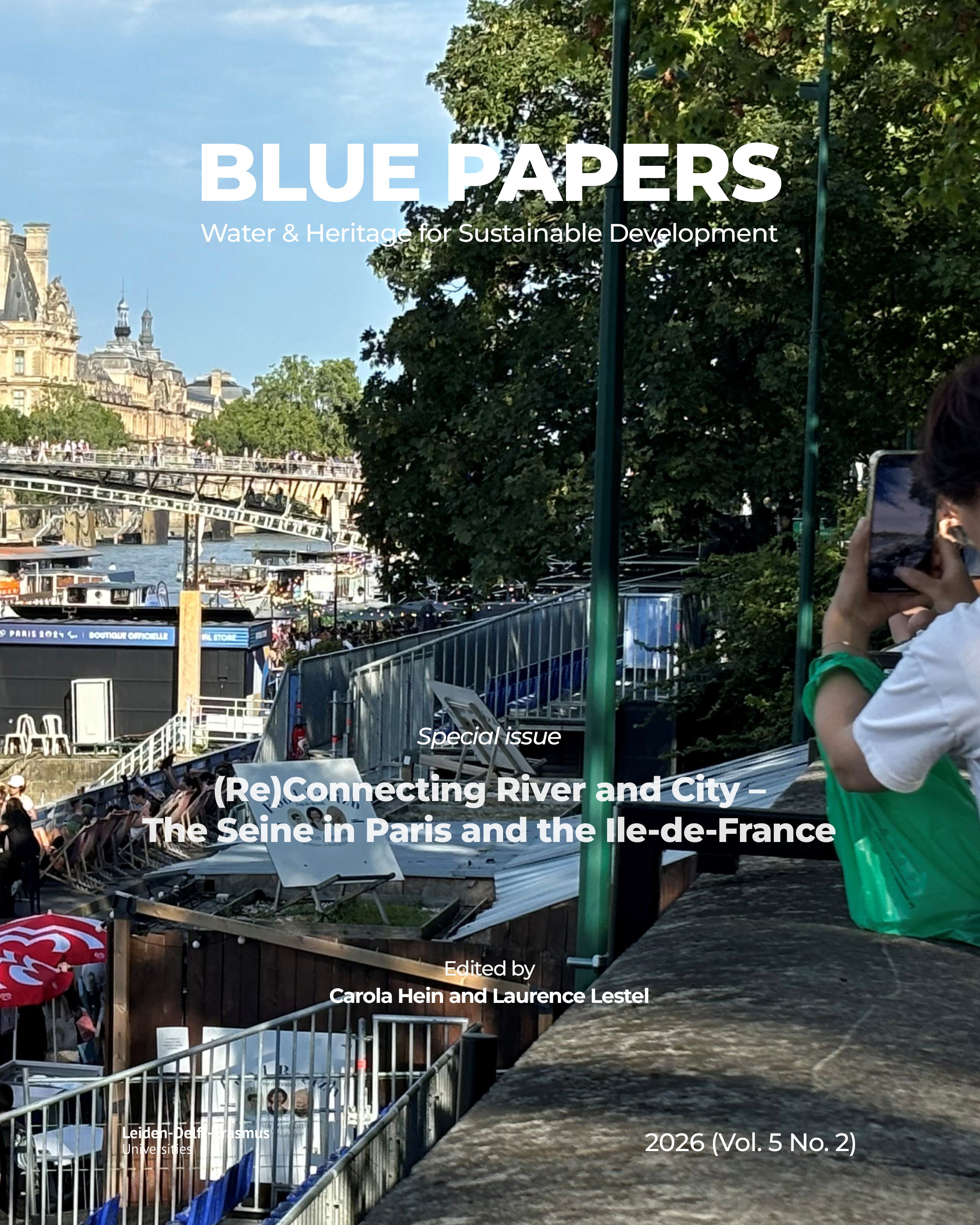
In France, this renewed relationship with water is taking visible form. The ambitious work to clean up the River Seine, to make it possible to swim again, and even to host the Olympic Games shows awareness and commitment. It shows that when a society decides to return life to a river, it can become a model for the world. It is a reminder that civic pride, environmental care, and technical innovation can flow together.
Coming from the Netherlands, I feel a deep kinship with that spirit. My country is built on wetlands, reclaimed from the sea over centuries through the construction of dikes, canals, and polders. For us Dutch, living below sea level feels completely normal — it’s so ingrained in our daily lives that we hardly think about it anymore. Living with water is not only part of Dutch history; it is part of our daily consciousness. From the bedtime stories our grandparents told us about floods and windmills to the policies that guide our water boards today, the presence — and sometimes the threat — of water has shaped our identity. It has taught us resilience, cooperation, and respect for nature’s power. Yet this very normalcy poses a challenge: we sometimes forget the real risks — the constant threat of water and the possibility of flooding that still looms large.
France and the Netherlands also share an old bond through this lens of water. The Dutch water management authority Rijkswaterstaat was created during the French period and remains a symbol of how our histories intertwine. Its mission extends beyond hydraulic works to protecting the built and cultural heritage — from rivers and canals to churches and towns that owe their existence to water.
For me, the connection to water is even more personal. My father used to tell stories of swimming in the Rhine — already, even then, one of the busiest inland shipping routes in the world. Those stories belong to another time, but they capture something essential: how everyday encounters with water nurture awareness and respect. When you grow up swimming in rivers, you learn to pay attention — to currents, to cleanliness, to the life within the water.
Years later, I had the opportunity to swim in the Seine myself during the opening of the site Bercy in the 12th arrondissement in Paris. That experience left a lasting impression. It was not only a dip in the river but a small act of faith — in the idea that we can keep our rivers alive, that the water running through our cities can once again be part of our lives. I was also able to join a passionate surfer-activist on the Canal Saint-Martin, the “Plastic Soup Surfer,” raising awarenes for the fight against plastic pollution. Moments like these remind us that personal awareness and public action are inseparable. You cannot protect what you do not know or feel connected to.
Healthy rivers depend on more than infrastructure. They rely on how people see and value them. Understanding water’s physical quality, its flow, and its presence in our environment is fundamental to maintaining living systems. It is also essential for fostering what I like to call a water mindset — one that inspires the next generation to engage with rivers not as distant resources, but as companions shaping urban life.
The Seine, like so many rivers, serves multiple purposes — transportation, recreation, ecology, heritage. Managing it requires coordination across municipalities, institutions, and communities. But beyond governance, it requires imagination: recognizing that rivers are not boundaries, but connectors. They link neighborhoods, histories and futures.
Reconnecting cities and rivers is about rediscovering that reflection, about ensuring that the waters that run through our heritage also flow toward a sustainable future.


