Downloads
DOI:
https://doi.org/10.58981/bluepapers.2026.2.10Published
Issue
Section
License
Copyright (c) 2025 Geraldine Knatz

This work is licensed under a Creative Commons Attribution 4.0 International License.
How to Cite
Keywords:
blue economy, ports, leasing policies, NGO financial stability, public-private partnershipAbstract
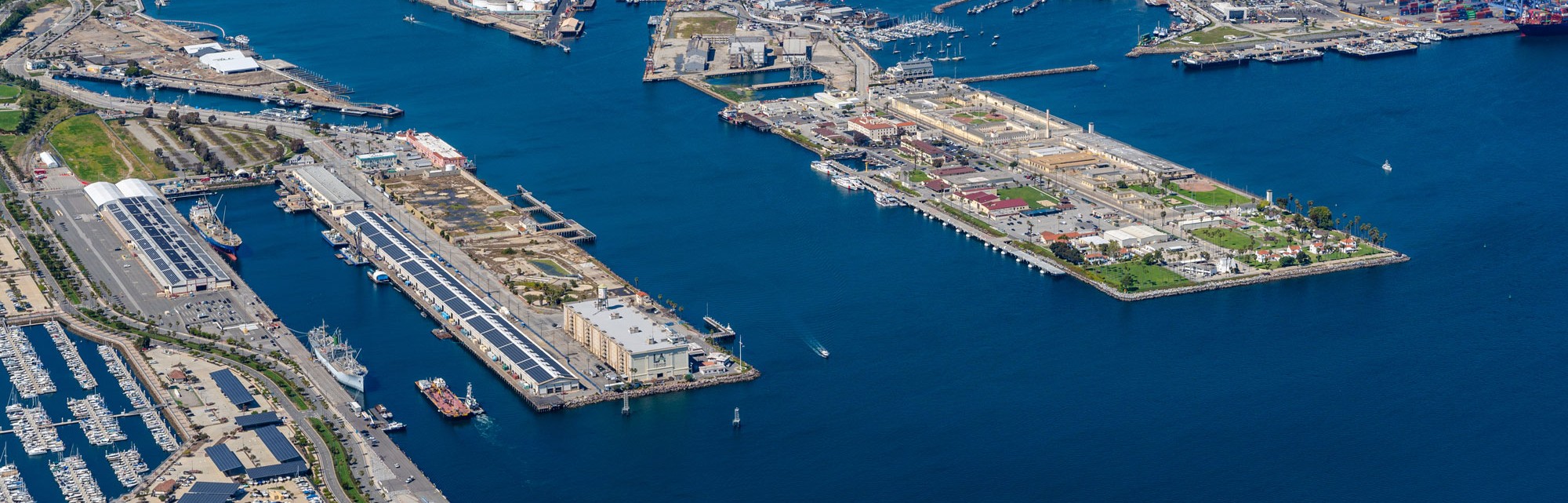
The concept of leveraging underutilized port assets to drive innovation and sustainability is gaining traction globally. This paper examines AltaSea at the Port of Los Angeles, a nonprofit organization operating a 35 acre (14 ha) ocean innovation campus located on a historic pier in the Los Angeles Outer Harbor. A modified leasing and valuation framework that formally recognizes non-compensatory public benefits, such as heritage conservation, public engagement, job creation, education and workforce development, enabled this public-private partnership (PPP) to revitalize an underutilized historic site. A 50-year agreement between the Port of Los Angeles and AltaSea was structured to allow the nonprofit to generate revenue for its longterm viability, ensuring its own mission and the rehabilitation of historic structures. The model suggests a replicable approach for ports seeking to activate historic maritime sites while supporting nonprofit led blue economy ecosystems.
References
ICF Jones & Stokes. 2008. Historic Resources Evaluation Report for Port of Los Angeles, Municipal Pier Nº 1. Prepared for the Los Angeles Harbor Department.
ICOMOS. 2011. The Dublin Principles: Joint ICOMOS–TICCIH Principles for the Conservation of Industrial Heritage Sites, Structures, Areas, and Landscapes. Paris. https://ticcih.org/about/about-ticcih/dublin- principles/.
Los Angeles Economic Development Corporation. 2025. The Blue Economy in Los Angeles County: Charting a Course Forward. https://laedc.org/download/the-blue-economy-in-los-angeles-county-charting-a-course-forward/#1.
OECD. 2025. The Ocean Economy to 2050. Paris: OECD Publishing. https://doi.org/10.1787/a9096fb1-en.
Port of Seattle. 2019. “The Economic Case for the Maritime Center at Fisherman’s Terminal.” Port of Seattle Commission meeting, January 9, agenda item 7c. https://meetings.portseattle.org/watch/meeting/ 2019_01_08_RM.
World Economic Forum. 2024. “World Maritime Day: How Ports Can Catalyze Blue Economy Innovation.” https://www.weforum.org/stories/2024/09/world-maritime-day-ports-blue-economy-innovation/.


