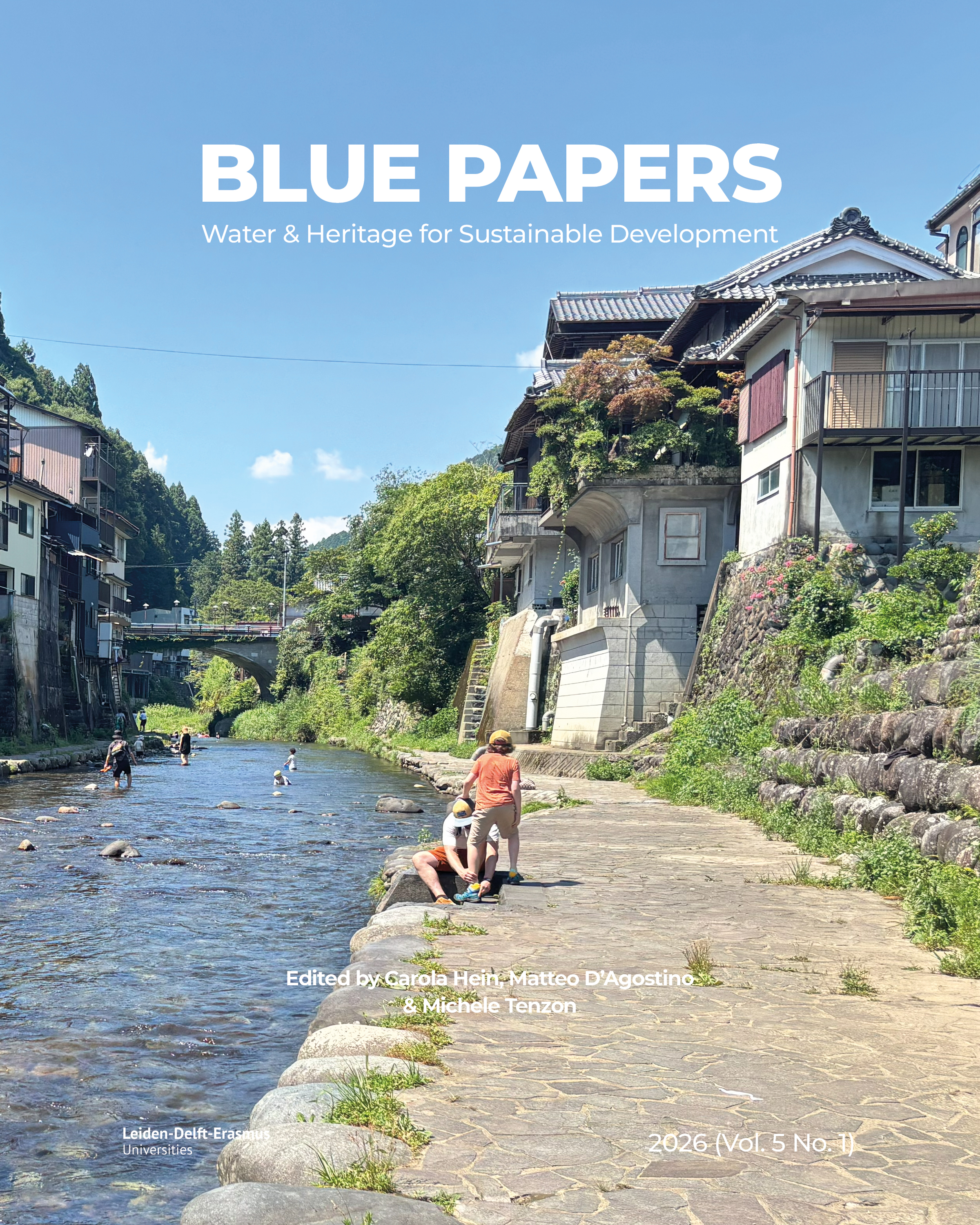
Editorial Issue 1/2026 Water and Heritage: From Centralized Legacies to Integrated Futures

Authors

Downloads

DOI:

https://doi.org/10.58981/f80whg36

Published

2026-06-06

How to Cite

Hein, C., Tenzon, M., & D’Agostino, M. (2026). Editorial Issue 1/2026 Water and Heritage: From Centralized Legacies to Integrated Futures. Blue Papers, 5(1), 8-12. https://doi.org/10.58981/f80whg36

Abstract

Blue Papers aims to inspire new approaches to water, culture, heritage and sustainable development. We believe historical and historiographical analysis can help shift the discourse from strategies focused on short-term gains to long-term approaches that consider both historical dynamics and the potential consequences of future developments. An analytical focus on water – its materiality and flows – can help shift the discourse from disconnected, monodisciplinary approaches to spatial, social and cultural analysis, connecting multiple scales, diverse stakeholders and local characteristics over time.

Author Biographies

  • Carola Hein, Delft University of Technology

    Carola Hein is Professor History of Architecture and Urban Planning at Delft University of Technology, Professor at Leiden and Erasmus University and UNESCO Chair Water, Ports and Historic Cities. She has published and lectured widely on topics in contemporary and historical architectural, urban and planning history and has tied historical analysis to contemporary development. Among other major grants, she received a Guggenheim and an Alexander von Humboldt fellowship. Her recent books include: Port City Atlas (2023), Oil Spaces (2021), Urbanisation of the Sea (2020), Adaptive Strategies for Water Heritage (2020), The Routledge Planning History Handbook (2018), Port Cities: Dynamic Landscapes and Global Networks (2011). Carola is also the leader of the PortCityFutures research group.

  • Michele Tenzon, Delft University of Technology

    Michele Tenzon teaches and conducts research in architecture and architectural history. His publications focus on the history of global architecture, with particular attention to the ecological transformations produced by the direct and indirect, tangible and intangible actions of imperialism, as well as by postcolonial relations and conditions. He recently authored the short book Designing the Rural-Urban Continuum (LetteraVentidue, 2024) and co-authored Architecture, Empire, and Trade (Bloomsbury, 2025).

  • Matteo D’Agostino, Delft University of Technology

    Matteo D’Agostino is a researcher at the Delft University of Technology, a member of the PortCityFutures research group, and currently affiliated with the UNESCO Chair for Water, Ports and Historic Cities. Matteo is a cultural anthropologist experienced in the analysis of perceptions and relational dynamics between public and private actors. His research focuses on understanding multiple structural, spatial and socio-economic factors as the basis for spatial planning and social interventions. Other interests include policy implementation for granting access to basic resources, such as water, and the strategic reinterpretation of heritage by institutional and activist organizations.

References

“Water, Climate and World Heritage: Navigating Threat and Opportunity”. 2025. Blue Papers 4 (2). https://doi.org/10.58981/bluepapers.2025.2.ed.