Icons as a Tool to Connect Water Practices, Functions and Values across Space and Time: A Second Attempt
Authors

Downloads

DOI:

https://doi.org/10.58981/ng7nyn80

Published

2026-06-06

Issue

Section

water, culture and heritage themes

How to Cite

Hein, C., Kayrouz, L., Sliwinska, Z., & D’Agostino, M. (2026). Icons as a Tool to Connect Water Practices, Functions and Values across Space and Time: A Second Attempt. Blue Papers, 5(1), X-5. https://doi.org/10.58981/ng7nyn80

Abstract

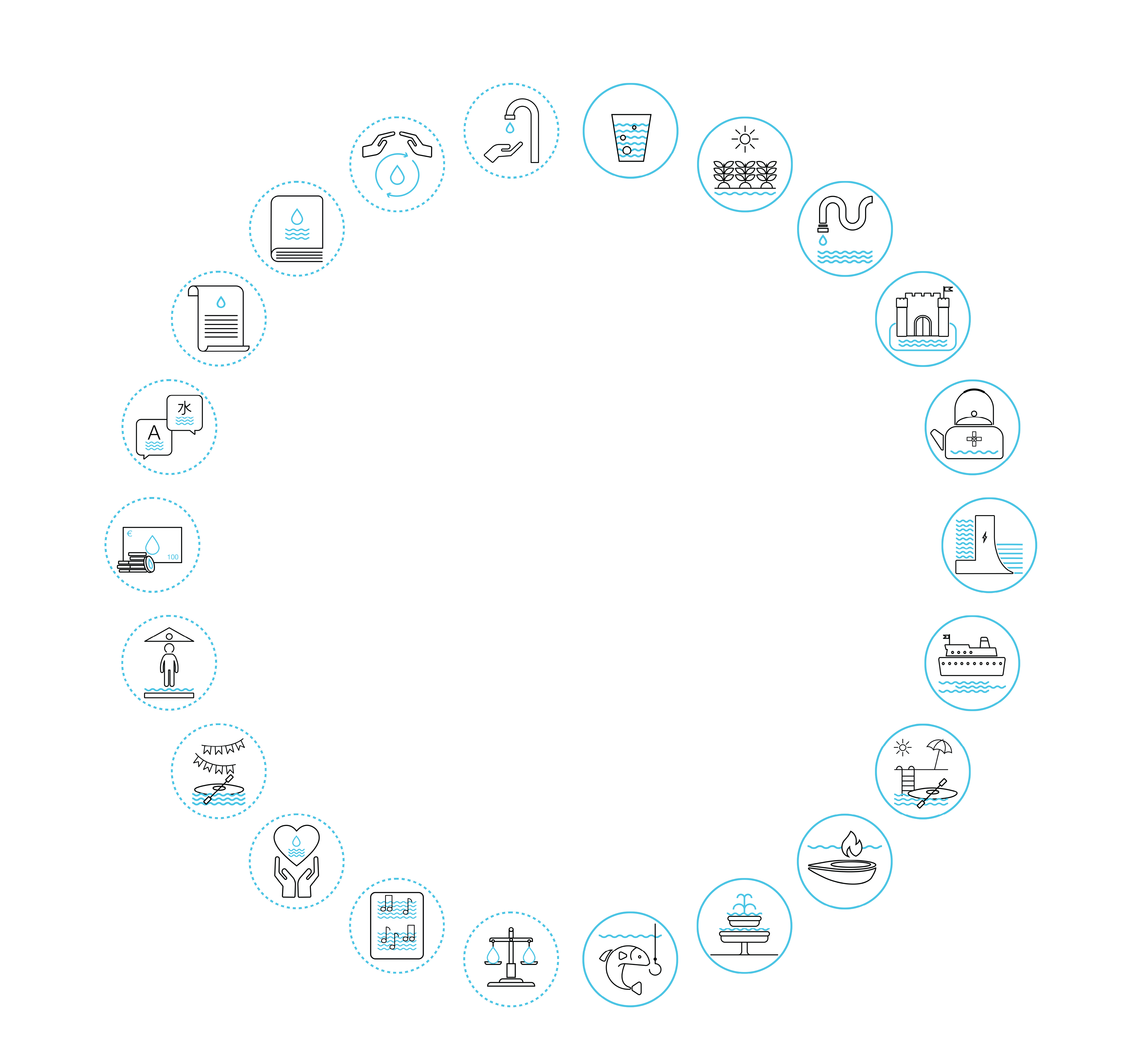
Humans have shaped water systems for millennia, creating complex networks of physical structures, institutions and cultural practices. These systems reflect locally embedded yet globally influenced values that evolve over time. From infrastructure and landscapes to rituals and laws, human engagement with water is both tangible and intangible, deeply influenced by societal preferences, climate conditions and historical choices. To better understand this diversity, we developed a set of icons to represent various water spaces, functions, practices and values. Rather than offering a fixed taxonomy, these icons are intended as tools for discussion – making visible the multiple dimensions of water and the meanings knowledge holders assign to it.   Originally introduced in 2022 (Hein et al. 2022), the icons were used by authors in our journal to highlight key themes in their work. While we envisioned them as a way to map specific water-related elements across time and geography, they also served as visual keywords, helping to reveal prominent aspects of water heritage and practice. This goal has guided our ongoing efforts to enhance the icons’ interpretive and comparative value, stimulating deeper cross-contextual reflection (Hein et al. 2025). In our second attempt to build a taxonomy of water practices, functions and values, we have introduced new icons and revised others, notably by adding representations of aesthetic and economic aspects and refining examples.   Ultimately, these categories are suggestions – not exhaustive or mutually exclusive – designed to illuminate how water has been managed, valued and lived with across different times and places, and how the past continues to influence the present and shape our future.   As we make the water icons open source (CC-BY) available for download on the Blue Papers website, we invite readers to build on the current set and expand it to fit their own context. The goal is to foster a dialogue around water values, invite collaborative engagement and spur new insights.   To represent situations where multiple water functions, values, and practices are considered together, we use a circle to group the corresponding icons.

Author Biographies

  • Carola Hein, Delft University of Technology

    Carola Hein is Professor History of Architecture and Urban Planning at Delft University of Technology, Professor at Leiden and Erasmus University, and UNESCO Chair Water, Ports and Historic Cities and serves as director of the PortCityFutures Center. She has published and lectured widely on topics in contemporary and historical architectural, urban and planning history and has tied historical analysis to contemporary development. Among other major grants, she received a Guggenheim and an Alexander von Humboldt fellowship. Her recent books include: Hustle and Bustle: The Vibrant Cultures of Port Cities (2024), Port City Atlas (2023), Oil Spaces (2021), Urbanisation of the Sea (2020), Adaptive Strategies for Water Heritage (2020), The Routledge Planning History Handbook (2018) and Port Cities: Dynamic Landscapes and Global Networks (2011).

  • Lea Kayrouz, Delft University of Technology

    Léa Kayrouz is a researcher in the Department of History of Architecture and Urban Planning at Delft University of Technology’s Faculty of Architecture, where she recently earned her Master’s degree. Her work has focused on projects related to valuing water, including collaborations with Rijkswaterstaat (the Dutch Ministry of Infrastructure and Water Management).

    Léa has contributed to the development of two professional education courses and co-authored an article on the preservation of the Dutch Waterlinie. Additionally, Lea has worked with colleagues on developing and refining the value case approach and was responsible for compiling the entry of Paris into UNESCO’s World Heritage Urban Atlas.

  • Zuzanna Sliwinska, Independent researcher

    Zuzanna Sliwinska is a researcher with a background in architecture and urban planning. She focuses on the intersection of heritage preservation and water systems, with interest in climate change adaptation and socio-ecological interactions. Following her master’s degree at Delft University of Technology (cum laude), she did an internship at the World Heritage Centre focusing on World Heritage and climate change. She has since collaborated with the UNESCO Chair of Water, Ports, and Historic Cities on projects that develop frameworks for integrating water heritage into climate-resilient urban planning. She has also worked with interdisciplinary initiatives such as the PIREN-Seine scientific program at Sorbonne University, alongside leading self-initiated research projects. Zuzanna has been involved with the Blue Papers journal since its establishment and has held an editor role for the past two years.

  • Matteo D’Agostino, Delft University of Technology

    Matteo D’Agostino is a researcher at the Delft University of Technology, a member of the PortCityFutures research group, and currently affiliated with the UNESCO Chair for Water, Ports and Historic Cities. Matteo is a cultural anthropologist experienced in the analysis of perceptions and relational dynamics between public and private actors. His research focuses on understanding multiple structural, spatial and socio-economic factors as the basis for spatial planning and social interventions. Other interests include policy implementation for granting access to basic resources, such as water, and the strategic reinterpretation of heritage by institutional and activist organizations.

References

Hein, Carola, Matteo D’Agostino, Carlien Donkor, Hilde Sennema and Queenie Lin. 2022. “Capturing Water, Culture and Heritage through Icons: A First Attempt.” Blue Papers 1, no. 1: 1–3. https://bluepapers.nl/index.php/bp/article/view/19.

Hein, Carola, Lea Kayrouz, Zuzanna Sliwinska and Matteo D’Agostino. 2025. “A Taxonomy of Water Practices, Functions and Values across Space and Time: Water Icons 2.0.” Blue Papers 4, no. 1: 14–25. 10.58981/bluepapers.2025.1.taxo.