Downloads
DOI:
https://doi.org/10.58981/bluepapers.2026.2.18Published
Issue
Section
License
Copyright (c) 2025 Clément Brun, Léonard Bertrand, Annabelle Nantier

This work is licensed under a Creative Commons Attribution 4.0 International License.
How to Cite
Keywords:
urban swimming, harbor, governance, regulation, navigationAbstract
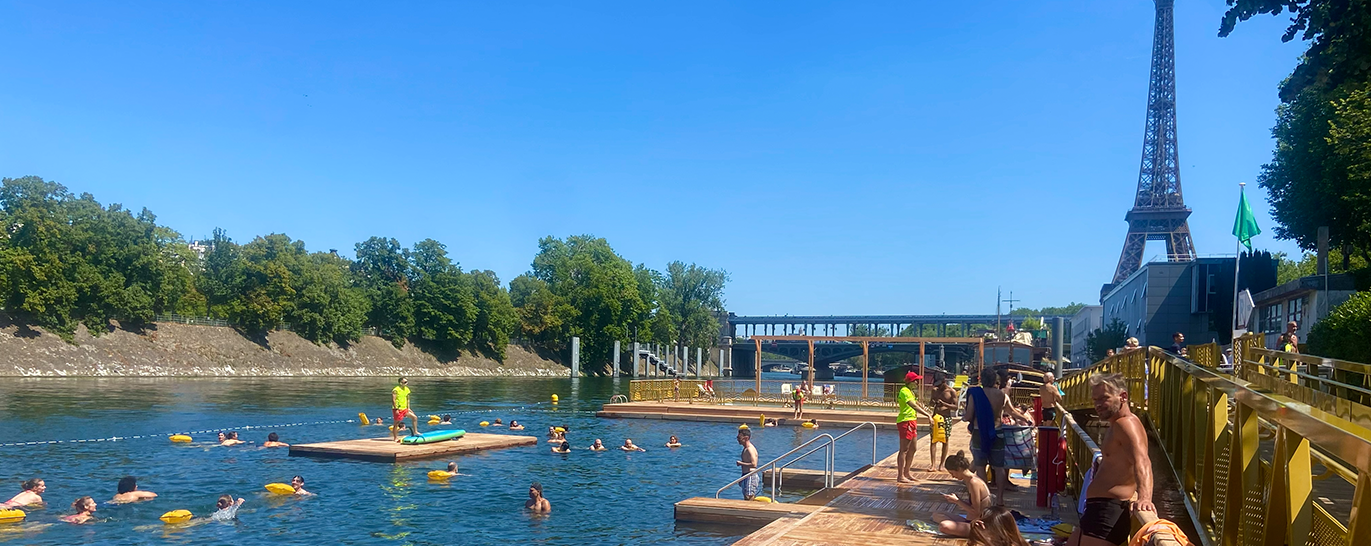
This article examines the reintroduction of swimming in the Seine from a dual perspective: first, the technical and regulatory constraints specific to Paris; second, the need to broaden the scope toward long-term territorial planning. In the first part, the authors show how floating bathing facilities must contend with regulations designed for river navigation rather than swimming. This framework imposes sometimes unsuitable standards (freeboard, ERP classification, navigation police regulations) leading to a highly controlled and formalized design of sites, though one deemed necessary to ensure the coexistence of multiple uses of the river. In its second part, the authors warn against the limitations of a single model – the enclosed pool – which fails to reflect the diversity of urban swimming practices and may in fact encourage informal, unsupervised swimming. Drawing on the example of Copenhagen, the authors argue for an integrated metropolitan strategy that embraces diverse forms of access to the water, making swimming a durable component of Paris’s territorial development.
References
Augustin, Jean-Pierre and André Suchet. 2016. “Pratiques sportives et projets de territoire” [Sports practices and territorial projects]. Cahiers de géographie du Québec 60 (171): 433–438. https://doi.org/10.7202/1041215ar.
Bertrand, Léonard. 2024. “Quand la ville décoïncide son rapport au fleuve: La baignade en Seine à l’épreuve des institutions” [When the city decouples its relationship with the river: Swimming in the Seine put to the test of institutions]. Master’s thesis, Université Paris 1 Panthéon-Sorbonne.
Bouleau, Gabrielle, Françoise Lucas and Jean-Marie Mouchel, eds. 2024. La baignade en Seine et en Marne [Swimming in the Seine and the Marne]. Fascicule no. 21. Paris: ARCEAU-IdF.
Brun, Clément. 2025. The Contemporary City Between the Waters: Architecture, the Active Body and Recreational Practices. The New Harbor Baths of Copenhagen. Doctoral diss., Université de Bordeaux.
Brun, Clément. 2024. “La Seine baignable: un pari sous tension. La conciliation des usages dans l’aménagement des sites de baignade en Seine” [A swimmable Seine: a tense wager. Reconciling uses in the planning of swimming sites in the Seine]. Master’s thesis, École d’urbanisme de Paris.
Largey, Thierry. 2023. “Baignade en eau libre: quelles limites à la responsabilité individuelle en droit suisse ?” [Open-water swimming: what limits to individual responsibility in Swiss law?] Paper presented at Droit des baignades, droits aux baignades: L’accès aux rivières urbaines face au réchauffement climatique, EHESS Centre des colloques, Campus Condorcet, Paris, September 28, 2023.
Lascoumes, Pierre, Odile Timbart, Nathalie Danglade, Isabelle Sillon and GAPP. 1994. Environnement et ordre public [Environment and public order]. Paris: Ministère de l’Environnement.
Nantier, Annabelle. 2025. “La limite, outil de reconquête de la Seine” [The boundary as a tool for reclaiming the Seine]. Paper presented at Cycle de réflexions Architecture de l’Eau, AAIIA.
Paquot, Thierry. 2004. “Ville et nature, un rendez-vous manqué ?” [City and nature: a missed encounter?] Diogène 207 (3): 83–94. https://doi.org/10.3917/dio.207.0083.


