Downloads
DOI:
https://doi.org/10.58981/bluepapers.2026.1.15Published
Issue
Section
License
Copyright (c) 2025 Rhoda Osei-Nkwantabisa, Martin Larbi

This work is licensed under a Creative Commons Attribution 4.0 International License.
How to Cite
Keywords:
erosion, flooding, habitable islands, heritage preservation, coastal managementAbstract
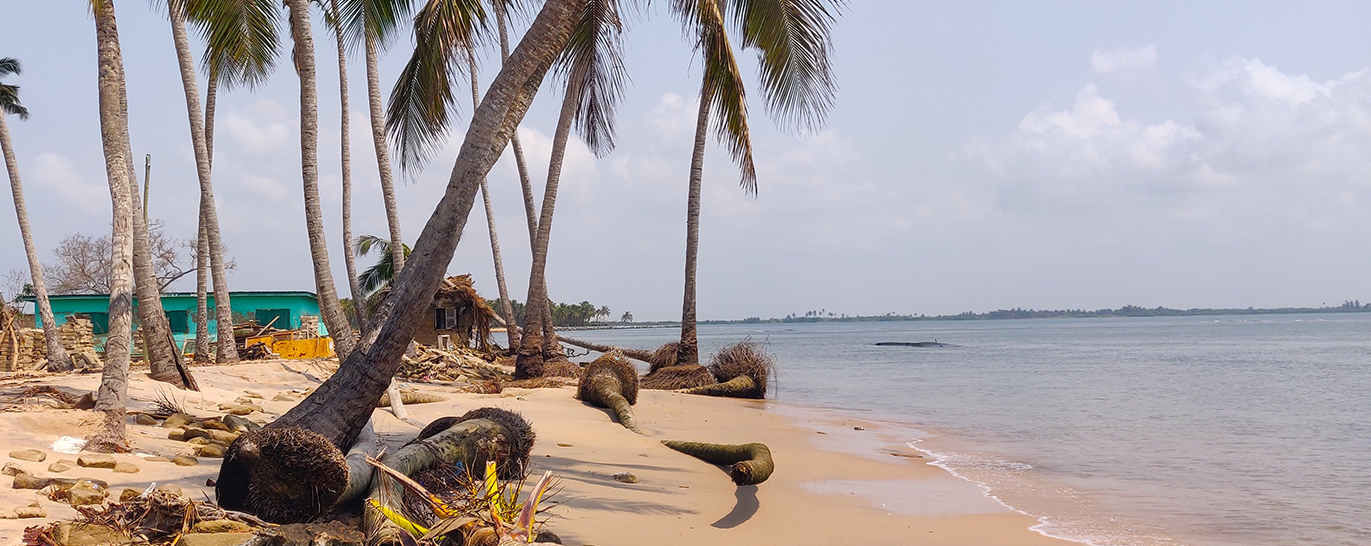
Islands have built their culture and heritage around bodies of water. However, due to climate change, the coastal islands are steadily disappearing because of severe flooding and erosion, as in the case of Azizakpe, a fishing community whose history and culture are strongly connected to water. Human activities, including the dredging of the estuary, along with sea level rise exacerbated by global climate change are the primary drivers for this loss. Although various coastal management and adaptation measures have been introduced, their outcomes remain uncertain. This study examines the Azizakpe community and the rapidly deteriorating state of the island. It highlights the effect on local livelihoods and how the community is attempting to cope with the situation and safeguard their water-based heritage, which will be at risk if islanders are displaced.
References
Alhassan, Henry Shirazu. 2009. “Viewpoint – Butterflies vs. Hydropower: Reflections on Large Dams in Contemporary Africa.” Water Alternatives 2 (1): 148–160.
Avornyo, Selasi Yao, Kwasi Appeaning Addo, Pietro Teatini, Philip S. J. Minderhoud, and Marie-Noëlle Woillez. 2023. “Vulnerability of Ghana’s Coast to Relative Sea Level Rise: A Scoping Review.” AFD Research Papers 282. Paris: Agence Française de Développement.
Chambers, Robert, ed. 1970. The Volta Resettlement Experience. London: Pall Mall Press.
European Environment Agency. 2024. “Global and European Sea Level Rise.” Accessed March 28, 2024. https://www.eea.europa.eu/en/analysis/indicators/global-and-european-sea-level-rise.
Intergovernmental Panel on Climate Change (IPCC). 2021. Climate Change 2021: The Physical Science Basis. Cambridge University Press.
Miescher, Stephan F. 2021. “Ghana’s Akosombo Dam, Volta Lake Fisheries and Climate Change.” Daedalus 150 (4): 124–142.
Nyekodzi, Gifty, Elaine T. Lawson, and Christopher Gordon. 2018. “Evaluating the Impacts of Dredging and Saline Water Intrusion on Rural Livelihoods in the Volta Estuary.” International Journal of River Basin Management 16 (1): 93–105. https://doi.org/10.1080/15715124.2017.1372445.
Scheyvens, Regina, and Janet Momsen. 2008. “Tourism in Small Island States: From Vulnerability to Strengths.” Journal of Sustainable Tourism 16 (5): 491–510. https://doi.org/10.1080/09669580802159586.
Sanza, Akesse. 2019. “Asafotufiam Festival: Remembering the Soldiers with War Festival.” Accessed October 20, 2024. https://jetsanza.com/asafotufiam-festival/.
Tsofanye, Naa Adjeley. 2016. “Asafotufiam.” The GaDangme. Accessed October 20, 2024. https://thegadangme.com/asafotufiami/.
Volta River Authority (VRA). 2022. “Non-Power Activities.” https://www.vra.com/subsidiaries/non_power_activities.php.


