Downloads
DOI:
https://doi.org/10.58981/bluepapers.2026.1.10Published
Issue
Section
License
Copyright (c) 2025 Ricky Purbaya, Rizki Dwika Aprilian, Miktha Farid Alkadri

This work is licensed under a Creative Commons Attribution 4.0 International License.
How to Cite
Keywords:
heritage management, harbormaster, Syahbandar, Spice Route, JavaAbstract
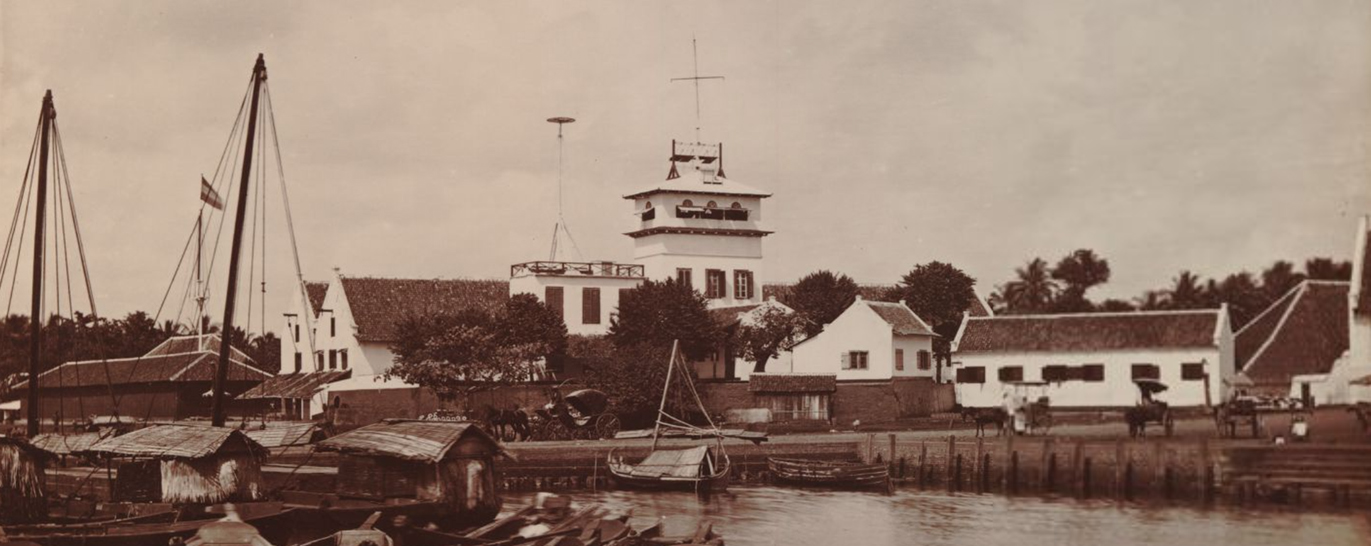
The north coast of Java has been well known to overseas traders as a hub for commodities, as well as spices brought from the Spice Islands (now Maluku Islands or the Moluccas). By the early nineteenth century, the Dutch government took control of the maritime trade in the region through the Dutch East India Company and developed the major port cities of Jakarta (formerly Batavia), Surabaya and Semarang, where the remnants of the colonial past continue to exist. After Indonesia’s independence, several colonial port structures, such as the harbormaster tower and its riverside facilities, were neglected until recently, when cities began programs to restore them. This article examines the preservation and adaptive reuse of historic towers in Java’s three major port cities and attempts to revive them amid the climate crisis challenges.
References
Aprilian, Rizki Dwika, and Indah Widiastuti. 2021. “The Story of Adaptive Reuse in Jakarta’s Old Buildings under the ‘Instagrammable’ Era.” In Proceedings of the ARTEPOLIS 8: The 8th Biannual International Conference. https://doi.org/10.2991/assehr.k.211126.019.
Brooker, Graeme, and Sally Stone. 2004. Rereadings: Interior Architecture and the Design Principles of Remodelling Existing Buildings. London: RIBA Publishing.
Damayanti, Vera D., Hasti Tarekat Dipowijoyo, Kemas Ridwan Kurniawan, Jacqueline Rosbergen, Peter Timmer, and Punto Wijayanto. 2021. Historic Urban Landscape (HUL) Quick Scan Method Handbook for Indonesian University Lectures. Depok, Indonesia: Department of Architecture, Faculty of Engineering, Universitas Indonesia.
Plevoets, Bie, and Koenraad Van Cleempoel. 2019. Adaptive Reuse of the Built Heritage: Concepts and Cases of an Emerging Discipline. London: Routledge. https://doi.org/10.4324/9781315161440.
Soedarsono, Woerjantari. 2011. Pelestarian Kota Tua di Indonesia [Preservation of Old Cities in Indonesia]. Jakarta: Direktorat Cagar Budaya Bawah Air dan Masa Kolonial.
Stone, Sally. 2020. UnDoing Buildings: Adaptive Reuse and Cultural Memory. London: Routledge.
Wong, Liliane. 2017. Adaptive Reuse: Extending the Lives of Buildings. Basel: Birkhäuser.
Yusuf, Nur Fadilah. 2023. “Pelabuhan Baru Batavia: Transformasi Pelabuhan Tanjung Priok, 1883–1925” [The New Port of Batavia: The Transformation of Tanjung Priok Port, 1883–1925]. Handep: Jurnal Sejarah dan Budaya 7 (1): 61–80. https://doi.org/10.33652/handep.v7i1.456.


