Downloads
DOI:
https://doi.org/10.58981/bluepapers.2026.1.12Published
Issue
Section
License
Copyright (c) 2025 Leonardo Zuccaro Marchi, Shubham Majumder, Sara Sabry

This work is licensed under a Creative Commons Attribution 4.0 International License.
How to Cite
Keywords:
Banaue, rice terrace, water systems, vernacular, landscapeAbstract
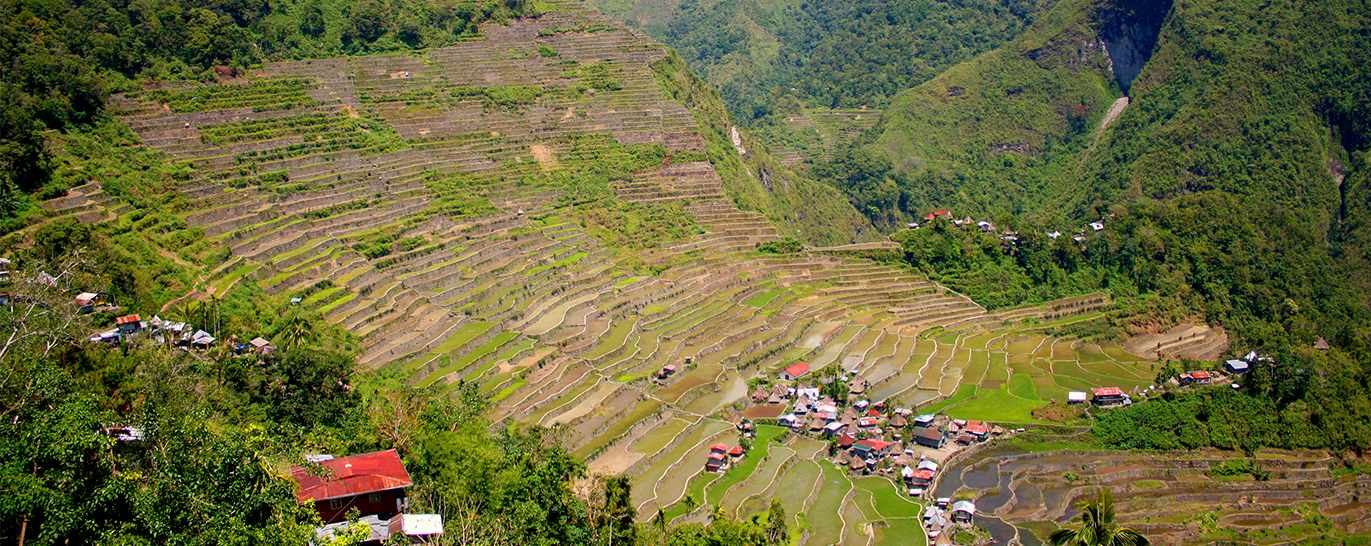
The traditional ecological knowledge (TEK) that is deeply embedded in the Ifugao Rice Terraces offers crucial insights for socio-ecological adaptation and resilience in times of climate change. It helps sustain local biodiversity and supports ecosystem processes while inspiring new design ideas that encourage an epistemological shift that involves integrating traditional knowledge with incremental innovations from the past into future solutions. The Second Terrace Lodge research-by-design project highlights the importance of the Ifugao community’s local landscape and cultural heritage, illustrating how traditional water and land management can be integrated into contemporary architecture and landscape design.
References
Acabado, Stephen. 2009. “A Bayesian Approach to Dating Agricultural Terraces: A Case from the Philippines.” Antiquity 83 (321): 801–14. https://doi.org/10.1017/S0003598X00099002.
Baldo, Jan Nicholas S., Alexis M. Fillone, and Nicanor Roxas Jr. 2017. “Characterizing Tourism Accessibility of Sagada, Mountain Province and Banaue, Ifugao Philippines.” Proceedings of the Eastern Asia Society for Transportation Studies 11: 1–15.
Camacho, Leni, et al. 2012. “Traditional Forest Conservation Knowledge/Technologies in the Cordillera, Northern Philippines.” Forest Policy and Economics 22: 3–8. https://doi.org/10.1016/j.forpol.2010.06.001.
Camacho, Leni D., Dixon T. Gevaña, †Antonio P. Carandang, and Sofronio C. Camacho. 2016. “Indigenous Knowledge and Practices for the Sustainable Management of Ifugao Forests in Cordillera, Philippines.” International Journal of Biodiversity Science, Ecosystem Services and Management 12 (1–2): 5–13. doi:10.1080/21513732.2015.1124453.
Conklin, Harold C. 1980. Ethnographic Atlas of the Ifugao: A Study of Environment, Culture, and Society in Northern Luzon. Yale University Press.
De Leon, Jeremy, Ashly Medrano, Adrian Carl Nicolas Julian, Miguel Carlo Campos Quintos, and Jeanne Gabrielle Rivera Serote. 2021. “Exploring the Knowledge of the Ifugao Youth on Ifugao Mythology.” Presented to the Faculty of the Multimedia Arts Department, School of Design and Arts, De La Salle-College of Saint Benilde (April). https://doi.org/10.13140/RG.2.2.11871.59040.
Droogers, Peter. 2004. “Adaptation to Climate Change to Enhance Food Security and Preserve Environmental Quality: Example for Southern Sri Lanka.” Agricultural Water Management 66 (1): 15–33. https://doi.org/10.1016/j.agwat.2003.09.005.
Dulnuan, Eulalie D. 2014. “The Ifugao Rice Terraces Tourism: Status, Problems and Concerns.” IAMURE International Journal of Ecology and Conservation 10 (1): 19–31. https://doi.org/10.7718/ijec.v10i1.772.
Gómez-Baggethun, Erik, Esteve Corbera, and Victoria Reyes-García. 2013. “Traditional Ecological Knowledge and Global Environmental Change: Research Findings and Policy Implications.” Ecology and Society 18 (4): 72. https://doi.org/10.5751/ES-06288-180472.
Herath, Srikantha, Johanna Diwa-Acallar, Yuanmei Jiao, and Peter P. Castro. 2015. “Overview of Rice Terrace Farming Systems in Hani and Ifugao: Water Management and Current Threats.” Rice Terrace Farming Systems Working Paper Series 1. PDF, ResearchGate. Accessed January 11, 2025. https://www.researchgate.net/publication/359991351_Overview_of_Rice_Terrace_Farming_Systems_in_Hani_and_Ifugao_Water_Management_and_Current_Threats_Working_Paper_Series_Number_01.
IUCN. 2002. Report on the State of Conservation of Natural and Mixed Sites Inscribed on the World Heritage List. Gland, Switzerland. https://unesdoc.unesco.org/ark:/48223/pf0000128742.
Jang, Jae Woo, and Scott Platt Salcedo. 2013. “The Socio-Political Structure That Regulates the Ifugao Forest Maintenance.” IPCBEE 58 (18): 86–92. https://doi.org/10.7763/IPCBEE.2013.V58.18.
Kawasaki, Jintana. 2012. “Enhancing Indigenous Knowledge in Rice Terraces.” Our World. Accessed January 11, 2025. https://ourworld.unu.edu/en/enhancing-indigenous-knowledge-in-rice-terraces.
Negro, Chaepter. 2019. “Rice Terrace Degradation in Ifugao: Causation and Cultural Preservation.” Honors Projects 58. Accessed November 11, 2025. https://digitalcommons.iwu.edu/socanth_honproj/58.
Piesik, Sandra, ed. 2023. Habitat: Vernacular Architecture for a Changing Climate. Thames & Hudson Ltd.
SITMo. 2008. IMPACT: The Effects of Tourism on Culture and the Environment in Asia and the Pacific. UNESCO Bangkok. https://unesdoc.unesco.org/ark:/48223/pf0000182647.
UNESCO. n.d. “World Heritage Convention: Rice Terraces of the Philippine Cordilleras.” Accessed January 11, 2025. https://whc.unesco.org/en/list/722/.
Watson, Julia. 2019. Lo-TEK: Design by Radical Indigenism. Taschen.
Zuccaro Marchi, Leonardo, Shubham Majumder, and Sara Sabry. 2024. “The Second Terrace Lodge [Reconnecting with Nature and Vernacular].” Terravivacompetitions. Accessed February 3, 2026. https://www.terravivacompetitions.com/banaue-lodge-competition-results-2024/.


