Downloads
DOI:
https://doi.org/10.58981/bluepapers.2026.1.09Published
Issue
Section
License
Copyright (c) 2025 Estere Cvilikovska

This work is licensed under a Creative Commons Attribution 4.0 International License.
How to Cite
Keywords:
irrigation system, ecosystem thinking, USSR, Turkmenistan, cross-border governanceAbstract
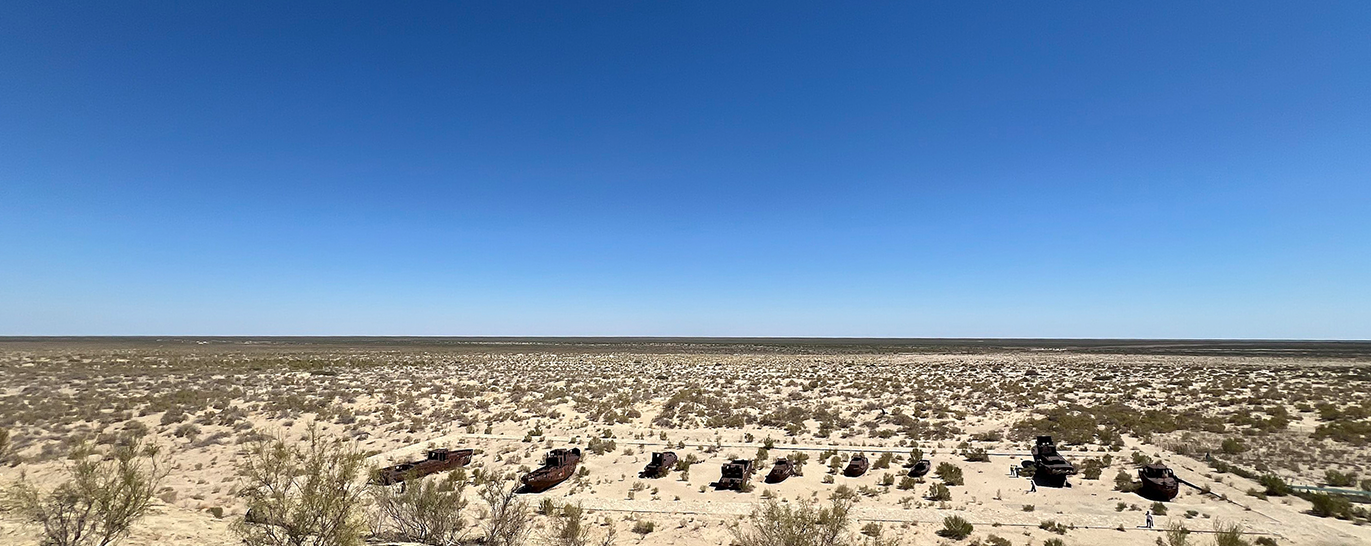
The collapse of the Aral Sea ecosystem is regarded as one of the most devastating environmental tragedies in history. Primarily driven by Soviet-era irrigation practices aimed at expanding agriculture in Central Asia’s arid regions, the catastrophe has had lasting ecological and socioeconomic consequences. To address the repercussions of past actions, it is essential to move beyond perceiving water as a “national” resource: It cannot be fully comprehended or effectively managed within national borders. An ecosystem-based approach can help divert from a technologically and economically based mono-functional value system, promoting possibilities for sustainable development in the region.
References
Brite, Elizabeth Baker. 2018. “The Hydrosocial Empire: The Karakum River and the Soviet Conquest of Central Asia in the 20th Century.” Journal of Anthropological Archaeology 52 (December): 123–36. https://doi.org/10.1016/j.jaa.2018.08.003.
Cvilikovska, Estere. 2026. “Historical Water Governance in Turkmenistan and the Challenges of Soviet Interventions.” Blue Papers 5 (1): 58–67. https://doi.org/10.58981/bluepapers.2026.1.05.
D’Agostino, Matteo, and Carola Hein. 2024. “Design-Based Solutions for Water Challenges: The Value Case Approach.” Blue Papers 3 (1): 80–89. https://doi.org/10.58981/bluepapers.2024.1.06.
Ghaderian, Massoud. 2022. “Collaboration between Nature and Humans in the Desert.” Blue Papers 1 (1): 139–149. https://doi.org/10.58981/bluepapers.2022.1.14.
Harriman, Lindsey. 2015. “The Future of the Aral Sea Lies in Transboundary Co-operation.” World Meteorological Organization, November 12, 2015. https://wmo.int/media/magazine-article/future-of-aral-sea-lies-transboundary-co-operation.
Jardine, Bradley. 2015. “Turkmenistan’s Water Insecurity Is a Man-Made Problem.” The Diplomat, July 14, 2015. https://thediplomat.com/2015/07/turkmenistans-water-insecurity-is-a-man-made-problem/.
Kachelson, Ju. I. 1987. Architecture of the Soviet Turkmenistan. Moscow: Stroiizdat.
Korzuna. 1982. “Ašhabada: Jaunība 100 gadu vecumā” [Ashgabat: Youth at 100 Years Old]. Rīgas Balss, November 9, 1982.
Liepa, L. 1981. “Kaleidoscope.” Komunists (July 1).
Maria, Ana, Marcin Dąbrowski, Kasia Pistorek, and Wout van den Toorn Vrijthoff. 2022. “Water-Linked Heritage as a Vector of Ecosystemic Change in Cities and Regions.” Blue Papers 1 (2): 78–89. https://doi.org/10.58981/bluepapers.2022.2.08.
Obertreis, Julia. 2017. Imperial Desert Dreams. Vandenhoeck & Ruprecht Verlage.
Peterson, Maya Karin. 2019. Pipe Dreams: Water and Empire in Central Asia’s Aral Sea Basin. Cambridge University Press.
Sein, V. 1962. “Vesi Tuli Karakumi” [Water Became Karakumi]. Kodumaa (October 24).
Sheraz, Muhammad. 2022. “Emerging Water Crisis in Central Asia.” Water Magazine (August 8). https://www.watermagazine.co.uk/2022/08/08/emerging-water-crisis-in-central-asia/.
Ūdresola, L. 1977. “Skaitļi Un Fakti” [Figures and facts]. Ļeņina Karogs (May 5).
Yakubov, Murat. 2021. “Small Basin Governance Scheme: Linking Water Sector Reforms and Governance in the Aral Sea Basin.” International Journal of Water Resources Development 38 (5): 1–32. https://doi.org/10.1080/07900627.2021.1926936.
Wæhler, Turid Austin, and Erik Sveberg Dietrichs. 2017. “The Vanishing Aral Sea: Health Consequences of an Environmental Disaster.” Tidsskrift for Den Norske Legeforening 137 (October). https://doi.org/10.4045/tidsskr.17.0597.


