Downloads
DOI:
https://doi.org/10.58981/denvky08Published
Issue
Section
License
Copyright (c) 2025 Gabriela Costea, Pippa de Kinder, Habil Martin Pusch

This work is licensed under a Creative Commons Attribution 4.0 International License.
How to Cite
Keywords:
Danube, exhibition concept, participatory approach, citizen engagement, multicultural contextAbstract
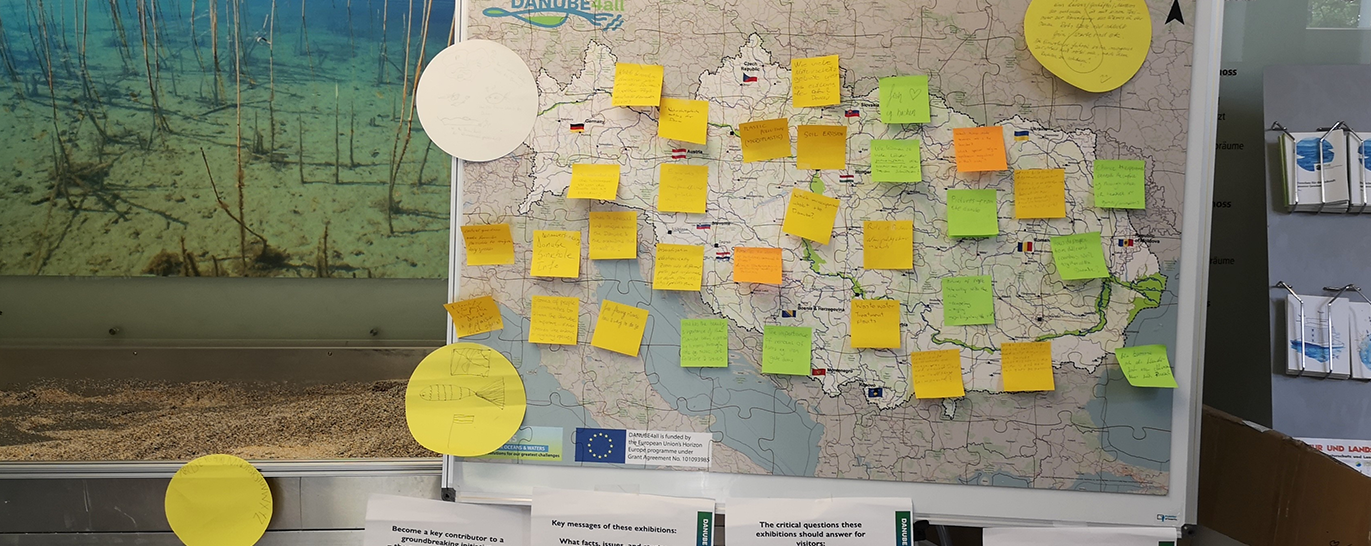
Protecting and restoring rivers and floodplains, which are affected by many different human activities, requires the active participation of stakeholders and citizens. To support this, a co-creation approach was developed to gather citizens’ suggestions for conceptualizing a traveling exhibition on the Danube River that would provide environmental education about river and floodplain management. Because we aimed to reach citizens from a variety of cultural backgrounds in several countries, we developed a poster-sized interactive and collaborative wooden jigsaw puzzle of the Danube basin. This was used as an intuitive and integrative platform for interactions among citizens and stakeholders while they assembled the 88 pieces of the puzzle, to which they added Post-it® Notes with ideas for a future traveling exhibition to each puzzle piece. The Puzzle Wall was presented at 10 sites, mostly within the Danube basin, where 527 responses were collected from over 300 participants. This large-format puzzle map proved a successful engagement tool that motivated participants to share their insights and express their preferences, hence taking collective responsibility for addressing critical challenges in Danube River management.
References
Barnes, Pamela, and Gayle McPherson. 2019. “Co-Creating, Co-Producing and Connecting: Museum Practice Today.” Curator: The Museum Journal 62 (2): 257–67. https://doi.org/10.1111/cura.12309.
Ferguson, Maria, and Kate Renner. 2019. “A Museum without Walls: Community Collaboration in Exhibition Development.” Museum Scholar 2. https://articles.themuseumscholar.org/2019/05/01/tp_vol2fergusonrenner/.
Hein, George E. 1999. “Is Meaning Making Constructivism? Is Constructivism Meaning Making?” The Exhibitionist 18 (2): 15–18.
Knudsen, Line Vestergaard. 2016. “Participation at Work in the Museum.” Museum Management and Curatorship 31 (2): 193–211. https://doi.org/10.1080/09647775.2016.1146916.
Lynch, Bernadette T. 2011. “Custom-Made Reflective Practice: Can Museums Realise Their Capabilities in Helping Others Realise Theirs?” Museum Management and Curatorship 26 (5): 441–58. https://doi.org/10.1080/09647775.2011.621731.
Minott, Rachael. 2019. “The Past Is Now: Confronting Museums’ Complicity in Imperial Celebration.” Third Text 33 (4–5): 559–74. https://doi.org/10.1080/09528822.2019.1654206.
Mygind, Lærke, Anne Hällman and Peter Bentsen. 2015. “Bridging Gaps between Intentions and Realities: A Review of Participatory Exhibition Development in Museums.” Museum Management and Curatorship 30 (April):117–37. https://doi.org/10.1080/09647775.2015.1022903.
Nakashima, Sophie, and Chiara Del Gaudio. 2022. “Museum and Exhibit Design: How Forms and Places of Knowledge Exchange Influence Community Participation and Empowerment.” In DRS2022: Bilbao, 25 June - 3 July, Bilbao, Spain, edited by D. Lockton, S. Lenzi, P. Hekkert, A. Oak, J. Sádaba and P. Lloyd. Design Research Society (DRS). https://doi.org/10.21606/drs.2022.538.
Piacente, Maria. 2022. Manual of Museum Exhibitions. Rowman & Littlefield.
Simon, Nina. 2010. The Participatory Museum. https://participatorymuseum.org/.
Smithsonian Exhibits. 2018. A Guide to Exhibit Development https://exhibits.si.edu/wp-content/uploads/2018/04/Guide-to-Exhibit-Development.pdf
Wang Qi and Yanhui Lei. 2016. “Minds on for the Wise: Rethinking the Contemporary Interactive Exhibition.” Museum Management and Curatorship 31 (4):1–18. https://doi.org/10.1080/09647775.2016.1173575.


