Downloads
DOI:
https://doi.org/10.58981/bluepapers.2025.2.10Published
Issue
Section
License
Copyright (c) 2025 Luis José García-Pulido

This work is licensed under a Creative Commons Attribution 4.0 International License.
How to Cite
Keywords:
UNESCO Biosphere Reserve, historical uses of water, Andalusian channels, bioclimatism, heat dissipationAbstract
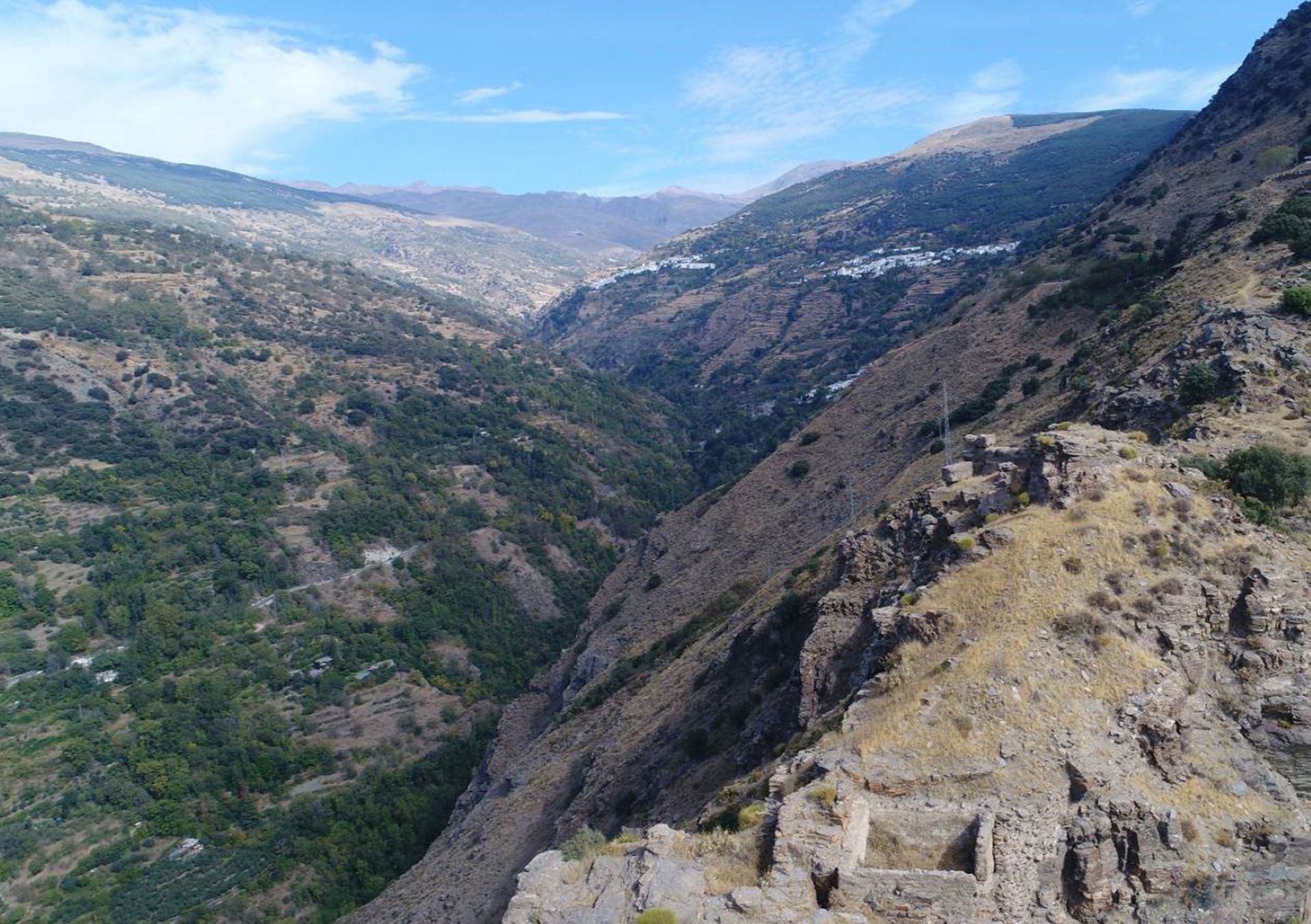
Recent changes in how water resources are managed in the Alpujarra – a vulnerable region on the southern slopes of the Sierra Nevada in Andalusia, Spain – are contributing to the degradation of formerly lush landscapes, which are now becoming increasingly arid under the pressure of global climate change. Poor water management practices risk pushing the environment beyond a point of no return, making recovery impossible unless the current climate emergency is addressed. It is therefore necessary to learn from the millennia-old culture and traditional processes of adaptation and resilience that have enabled communities in this region to thrive without overexploiting or depleting natural resources. This paper examines the village of Pampaneira, located in the Barranco de Poqueira, a heritage site within the Sierra Nevada UNESCO Biosphere Reserve. The village has historically practiced a unique and sustainable approach to water management, supporting human consumption, agriculture, daily activities, energy production and bioclimatic mechanisms established in the municipality.
References
Agencia Estatal de Meteorología (AEMET). 2024. “Registros climáticos.” https://www.aemet.es/es/idi/clima/registros_climaticos.
Agencia Estatal de Meteorología (AEMET). 2024 “Valores climatológicos normales.” Accessed July 4, 2025. AEMET: Registros climáticos. https://www.aemet.es/es/serviciosclimaticos/datosclimatologicos/valoresclimatologicos.
Baena Fernández, Juan. 2009. Guide Book to the Alpujarra of Granada: Mountain of the Sun or Magical Alpujarra. Mancomunidad de Municipios de La Alpujarra Granadina.
Castillo Martín, Antonio. 2008. “Fuente de Sonsoles (Pampaneira, Granada).” In Conoce tus fuentes: Manantiales y fuentes de Andalucía. Hacia una estrategia de conservación. Granada: Instituto Universitario de Investigación del Agua de la Universidad de Granada.
Castillo Martín, Antonio, and Luis Sánchez-Díaz. 2006. “Fuente de San Antonio (Pampaneira, Granada).” In Conoce tus fuentes: Manantiales y fuentes de Andalucía. Hacia una estrategia de conservación. Granada: Instituto Universitario de Investigación del Agua de la Universidad de Granada.
Delaigue, Marie Christine. 1995. “La red de acequias de la Alpujarra alta.” In El agua en la agricultura de al-Andalus, 144–59. El Legado Andalusí.
Dirección General de Infraestructuras del Agua de la Junta de Andalucía. 2024. Resumen de precipitación histórica (mm). Consejería de Agricultura, Pesca, Agua y Desarrollo Rural. https://www.redhidrosurmedioambiente.es/saih/resumen/precipitacion/historica.
García Moreno, Alberto, and David A. Garrido. 2007. “Central eléctrica del río Poqueira.” In Registro Andaluz de Arquitectura Contemporánea. Provincia de Granada. Instituto Andaluz del Patrimonio Histórico (IAPH).
Giguere, Juliette, Friederike E. L. Otto, Andrew Tannenbaum, Mimmi Vahlberg, and Julie Arrighi. Climate Change and the Escalation of Global Extreme Heat: Assessing and Addressing the Risks. Climate Central, Red Cross Red Crescent Climate Centre, and World Weather Attribution, 2025. https://www.worldweatherattribution.org/heat-action-day-report-climate-change-and-the-escalation-of-global-extreme-heat-2/.
Instituto Andaluz de Patrimonio Histórico. 2016. “Paisaje agrario del barranco de Poqueira y La Tahá (Granada).” In Paisajes de Interés Cultural de Andalucía. Consejería de Cultura de la Junta de Andalucía.
López-Osorio, José Manuel, Javier L. García and Sara P. Martín. 2020. “Agua y arquitectura en la Alpujarra de Granada (España): Una aproximación a los conjuntos hidráulicos de las fuentes y los lavaderos de la comarca.” Journal of Traditional Building, Architecture and Urbanism 1: 395–410.
Martos-Rosillo, Sergio, Ana Ruiz-Constán, Antonio González-Ramón, Rosa Mediavilla, Juan Manuel Martín-Civantos, Francisco José Martínez-Moreno, Jorge Jódar, Carlos Marín-Lechado, Alicia Medialdea, Jesús Galindo-Zaldívar, Antonio Pedrera and Juan José Durán-Valsero. 2019. “The Oldest Managed Aquifer Recharge System in Europe: New Insights from the Espino Recharge Channel (Sierra Nevada, Southern Spain).” Journal of Hydrology 578 (November): 124047. https://doi.org/10.1016/j.jhydrol.2019.124047.
Padilla Melado, Lorenzo Luis, ed. 2019. Libro del Apeamiento de los habices del Alpujarra, de las Tahas de Ferreyra, Poqueyra y Juviles que los apeó Benito de Carrión, escribano, año de 1527. Lorenzo L. Padilla Mellado.
Plaza-García, María del Pilar and R. García-Rubia. 2010. Actualización, digitalización y georreferenciación de la red de acequias de careo en el Espacio Natural Protegido de Sierra Nevada. TRAGSATEC-Consejería de Medio Ambiente de la Junta de Andalucía.
Pulido-Bosh, Antonio, and Younes B. Sbih. 1995. “Centuries of Artificial Recharge on the Southern Edge of the Sierra Nevada (Granada, Spain).” Environmental Geology 26: 57–63.
Robles-Arenas, Virginia María. 2009. “Fuente Cerrillo (Pampaneira, Granada).” In Conoce tus fuentes: Manantiales y fuentes de Andalucía. Hacia una estrategia de conservación. Instituto Universitario de Investigación del Agua de la Universidad de Granada.
Sánchez-Díaz, Luis, and Tomás Peinado Parra. 2015. “Fuente de Lavar (Pampaneira, Granada).” In Conoce tus fuentes: Manantiales y fuentes de Andalucía. Hacia una estrategia de conservación. Granada: Instituto Universitario de Investigación del Agua de la Universidad de Granada.
Trillo San José, Carmen. 2014. “La Alpujarra: Evolución del poblamiento de la Antigüedad a la Edad Media.” In El patrimonio cultural de la Alpujarra (Granada) y el territorio Jebala-Gomara (norte de Marruecos). Aproximación comparativa, edited by Julio Navarro Palazón, 27–48. Diputación de Granada. https://www.academia.edu/114422183.
Vivas, Gonzalo, E. Gómez-Landesa, Luciano Mateos and Juan V. Giráldez. 2009. “Integrated Water Management in an Ancestral Water Scheme in a Mountainous Area of Southern Spain.” In World Environmental and Water Resources Congress 2009: Great Rivers. https://doi.org/10.1061/41036(342)421.


